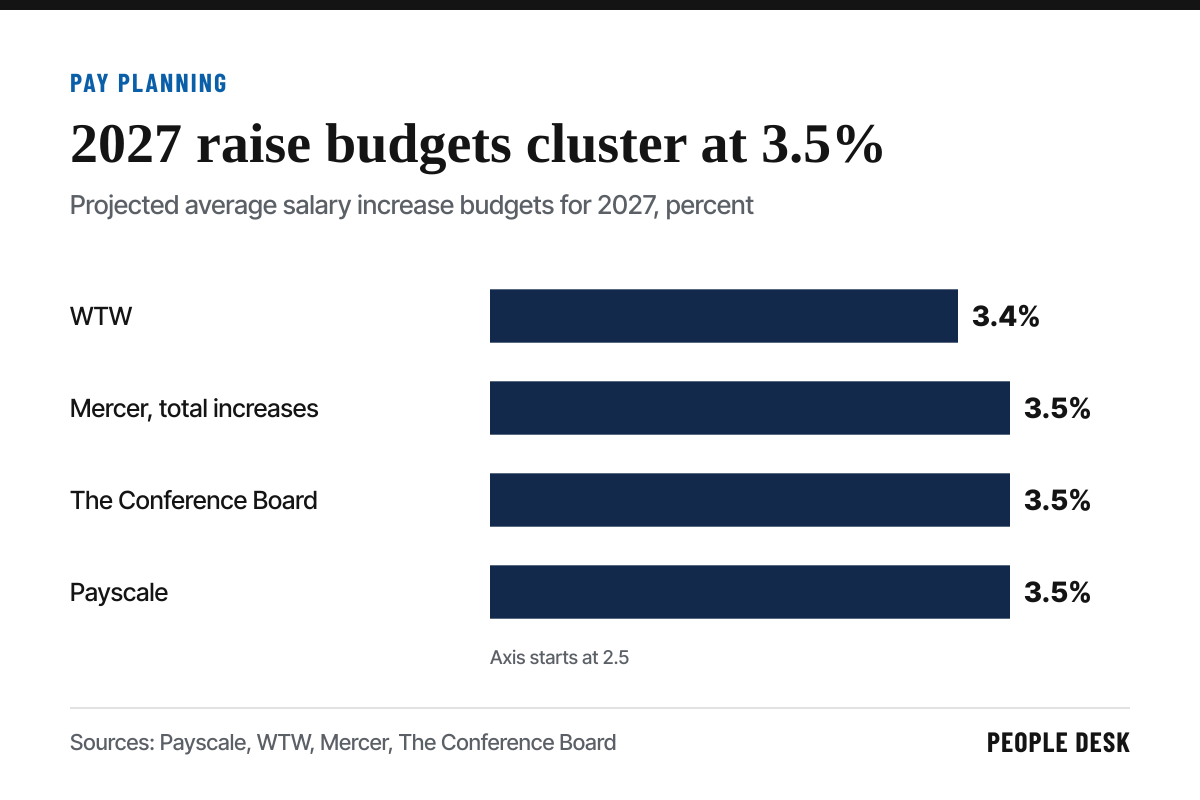
Salary planning season is nearly over, and the major compensation surveys have landed in a tight cluster. U.S. employers expect to raise pay by about 3.5 percent in 2027, almost exactly what they budgeted for 2026. For HR leaders, the headline number is settled. The real work is deciding how to split a modest pool across a workforce with very different expectations.
Sources: Payscale, WTW, Mercer and The Conference Board, fall 2026 surveys
What the surveys say
Payscale's 11th annual Salary Budget Survey found that U.S. companies expect to increase pay by an average and median of 3.5 percent in 2027, 0.1 point more than they reported giving in 2026. Nearly a third of respondents, 30 percent, said their 2027 budget would be higher than this year's. Only 8 percent expected a lower budget, and most of those cited concerns about economic conditions or business performance.
Other surveys agree within a few tenths of a point. WTW's survey of more than 34,000 companies projects average U.S. salary increase budgets of 3.4 percent for 2027, slightly below the 3.5 percent actually budgeted in 2026. Mercer's survey of 1,001 U.S. organizations found employers plan merit increases of 3.2 percent and total salary increases of 3.5 percent, including promotions and adjustments. The Conference Board projects a median salary increase budget of 3.5 percent, unchanged from 2026, with median merit budgets of 3.1 percent.
Gallagher's 2026 and 2027 salary survey of about 1,180 employers described budgets as stabilizing between 3 and 3.5 percent a year. After the large raises of the pandemic period, pay budgets have returned to a narrow, predictable band.
Fewer peanut butter raises
The more meaningful change is in how employers plan to spend the money. Payscale found that 36 percent of U.S. organizations gave across-the-board increases in 2026, the type of raise compensation professionals call peanut butter raises because they are spread evenly. Only 32 percent plan to do the same in 2027.
Merit increases remain the dominant approach. Payscale reports that 89 percent of companies offer merit raises, 69 percent offer promotional increases, 43 percent adjust salary structures and 31 percent provide inflation or cost-of-living increases. Of the projected 3.5 percent budget, about 3 percent is earmarked for merit.
That leaves very little for anything else. The Conference Board found the median budget for other increases, the flexible pool used for promotions, pay equity corrections, market adjustments and retention, is just 0.5 percent. Mercer's data shows wide variation by industry, with high tech employers budgeting 3.8 percent merit increases and consumer goods employers 2.9 percent.
How this compares with actual wage growth
Federal data shows a labor market where pay is rising steadily but not quickly. Average hourly earnings for private nonfarm workers reached $38.00 in October, according to the Bureau of Labor Statistics, and rose 3.1 percent over the year through August. A 3.5 percent budget keeps most employers roughly in line with the market, but it does not leave room to pull ahead.
That is a problem in roles where turnover is expensive. In hospitals, where losing a single bedside nurse costs about $60,000, an even split of a small budget can leave the hardest-to-replace employees underpaid relative to competitors.
Making a small budget work
Compensation advisers recommend a few practical steps. Start by identifying the roles where a pay gap is most likely to cause turnover, using exit data, quits by department and current job postings in your market. Fund those roles first, even if it means smaller merit increases elsewhere.
Next, check for pay compression. Starting rates have risen faster than raises in many hourly roles, and new hires can end up earning close to or more than experienced workers. Public pay ranges make compression visible, especially in states with pay transparency laws.
Finally, prepare managers for the conversation. Payscale and other researchers note that employees often accept a modest raise when they understand how it was decided and what would lead to a larger one. A manager who cannot explain the number will lose credibility, and a disengaged manager is already a growing risk, as Gallup's latest research shows.
The 2027 budget number is not a surprise. The organizations that use it well will be the ones that treat it as a set of deliberate choices about where pay matters most, and then explain those choices clearly to the people affected. For employers planning beyond pay, our guide to the real cost of turnover covers headcount and hiring costs.
Sources
- HR Dive, Payscale 2027 Salary Budget Survey
- HRMorning, Pay Increase Budgets for 2027
- CFO Dive, Fewer Companies Plan Across-the-Board Raises in 2027
- SHRM, 2027 Pay Raises Expected to Hold Largely Flat
- HR Brew, Moderate Raise Budgets for 2027
- The Conference Board via PR Newswire, Salary Increase Budgets Hold at 3.5% in 2027
- U.S. Bureau of Labor Statistics, The Employment Situation for October 2026
We link to the original reports and filings wherever possible. See something we got wrong? Tell us and read our corrections policy.


