Artificial intelligence dominated layoff headlines for much of 2026. For several months, it was the reason employers cited most often when announcing job cuts. The latest data from outplacement firm Challenger, Gray and Christmas shows that the story has changed, at least for now, and the shift holds lessons for how employers plan around new technology.
What the numbers show
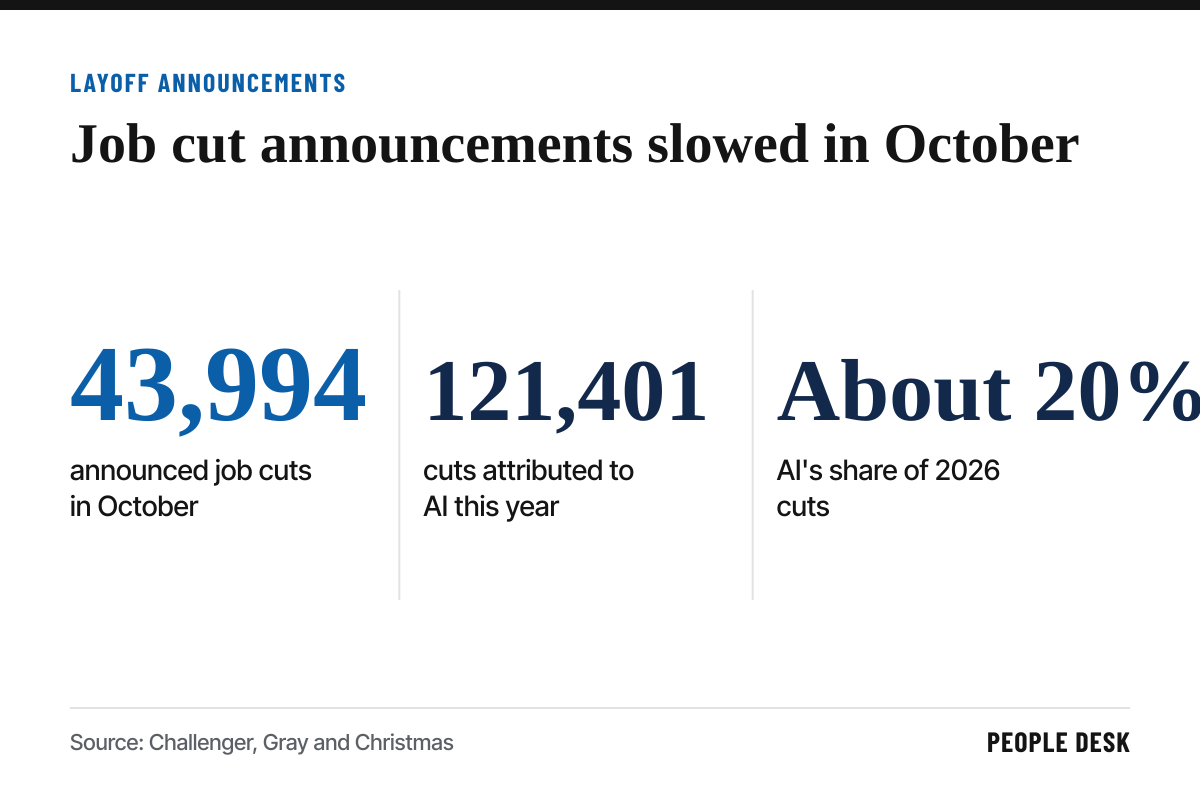
Through October, Challenger has tracked 121,401 announced job cuts attributed to artificial intelligence, roughly 20 percent of all cuts announced this year. AI led all reasons in Challenger's monthly reports from March through July, and at its reported peak in May it accounted for about 40 percent of announced cuts.
October looked very different. AI-attributed cuts fell to 1,265, less than 3 percent of the month's total, according to an analysis of the Challenger data. Technology companies announced 5,576 cuts in October, the lowest monthly tech figure of 2026. Through September, technology had accounted for 29 percent of all cuts announced this year, more than any other industry.
Market and economic conditions have replaced AI as the leading reason. Employers cited them for 16,407 cuts in October, about 37 percent of the total, and for 130,531 cuts so far this year. Total announced cuts through October reached 617,189, down 44 percent from the same period in 2025.
Reading the shift carefully
There are several ways to interpret the decline. One is that the mid-year wave of AI-related restructuring was concentrated among a handful of large technology firms and has largely run its course. Another is that companies have become more cautious about publicly attributing layoffs to AI, which can draw negative attention from employees, customers and regulators. A third is simply that slower economic conditions have become the more pressing reason for cuts.
Analysts watching the data have suggested that if AI attribution stays below about 5 percent in the November report, the spring and summer surge will look like a discrete event rather than a lasting trend. That report is due in early December.
What it means outside the tech sector
For most employers outside technology, AI has been a reason to change jobs rather than eliminate them. Gallup's research has found that manager-led AI adoption is one of the strongest drivers of frequent AI use among U.S. workers. In other words, employees tend to use AI tools when their own managers show them how, not when a company simply buys a license.
That makes AI a management and training question first. Organizations that redesign roles, train employees on new tools and set clear expectations about what AI should and should not do tend to see productivity gains without large layoffs. Organizations that skip those steps often end up with expensive software and anxious employees.
Legal and reputational exposure
Employers using AI in employment decisions also face a growing set of state rules. Illinois now requires notice when AI is used in hiring, promotion and discharge decisions, and other states have taken different approaches, as we explain in our AI hiring law guide. A restructuring that relies on algorithmic performance scoring could draw scrutiny under those laws.
Large layoffs of any kind also trigger federal notice requirements. Employers with 100 or more employees may owe 60 days of advance notice under the Worker Adjustment and Retraining Notification Act, which we cover in our WARN Act guide.
Planning ahead
The practical lesson from 2026 is that technology-driven restructuring tends to come in waves, and companies that plan workforce changes years in advance handle those waves better than companies that react. Mapping which tasks in each role could change, investing in retraining and building internal mobility paths gives employees somewhere to go when their work shifts.
Communication matters as much as the plan. Employees who hear about automation only through rumors tend to assume the worst and start looking elsewhere, often beginning with the strongest performers. Explaining which tasks will change, what training is available and how roles will be redesigned keeps uncertainty from turning into turnover.
Employers should also watch how candidates and employees perceive their use of AI. A company known for replacing people with automation may find recruiting harder, especially among younger workers who research employers carefully before they apply. Our report on what AI assistants say about employers explores how that reputation now travels.
Sources
- TechJack Solutions, October Tech Layoffs and AI-Attributed Cuts
- Challenger, Gray and Christmas, The Challenger Report
- Outsource Accelerator, October Job Cuts Lowest Since 2023
- Morningstar via Dow Jones, U.S. Employer Layoff Plans Fall in September
- Trading Economics, US Job Cuts Hit a Three-Year Low for October
- People Results, Gallup State of the Global Workplace 2026
We link to the original reports and filings wherever possible. See something we got wrong? Tell us and read our corrections policy.