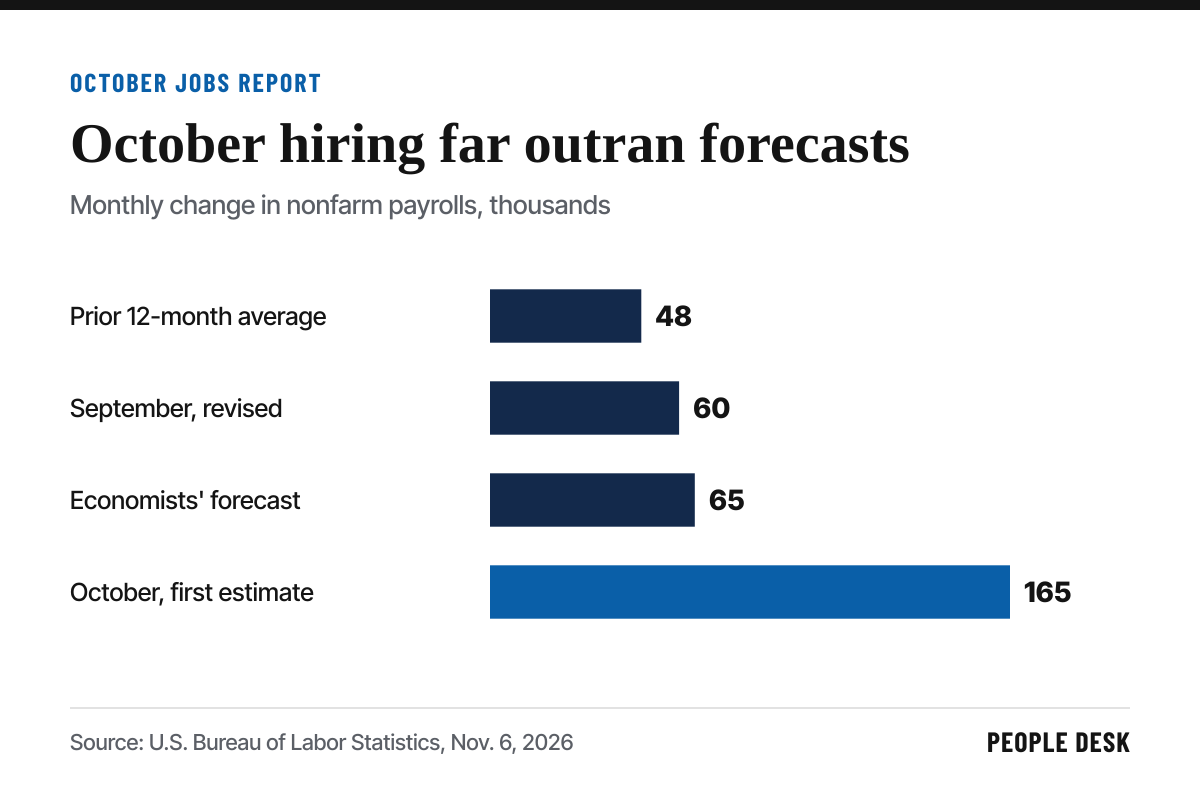
The October jobs report came in far stronger than Wall Street expected. Total nonfarm payrolls rose by 165,000, according to the Bureau of Labor Statistics, and the unemployment rate edged down to 4.1 percent. Economists surveyed by LSEG had looked for a gain closer to 65,000.
The revisions mattered almost as much as the headline. September was revised up from 29,000 to 60,000, and the combined total for August and September came in 84,000 higher than first reported. Over the prior 12 months, payrolls had grown by an average of only 48,000 a month, so October stands out against a slow year.
Source: U.S. Bureau of Labor Statistics and LSEG consensus, as reported November 6, 2026
Where the jobs came from
Private employers supplied 159,000 of the new positions and government added 6,000. Manufacturing continued a quiet recovery, adding 19,000 jobs in October and 101,000 since a low point in December 2025. The average factory workweek held at 40.5 hours. Readers who run plants will find more on that trend in our look at why keeping new manufacturing hires is now the harder task.
Pay kept rising at a measured pace. Average hourly earnings for private nonfarm workers increased 14 cents in October to $38.00. The unemployment rate has stayed between 4.1 and 4.3 percent since March, which tells employers the labor pool is neither flooding nor drying up.
Quits are climbing again
The more important signal for HR teams arrived a few days earlier in the Job Openings and Labor Turnover Survey. Openings rose to about 7.5 million in September, and the openings rate reached 4.5 percent. Quits jumped to 3.4 million, pushing the quits rate to 2.1 percent. Reuters noted that resignations hit their highest level since March 2025 while layoffs fell to 1.64 million, the lowest since that same month.
Economists read the quits rate as a confidence gauge. People rarely walk away from a paycheck unless they believe another one is waiting. Much of September's increase came from accommodation and food services, but the broader direction is clear enough. After a long stretch in which workers stayed put, more of them are testing the market.
That shift puts pressure on the people who supervise frontline teams. Gallup's latest global workplace study found that manager engagement fell faster than any other group, a problem we examine in our report on the manager engagement slide. When quits rise, the quality of the first-line manager often decides who stays.
Layoffs fell and seasonal hiring narrowed
Outplacement firm Challenger, Gray and Christmas counted 43,994 announced job cuts in October. That was the lowest October total since 2023 and 71 percent below the 153,074 cuts announced a year earlier. Through October, employers have announced 617,189 cuts, down 44 percent from the same period in 2025.
The reasons behind those cuts are shifting. Market and economic conditions were cited for 16,407 cuts in October, about 37 percent of the total, and that reason has now passed artificial intelligence as the leading driver of 2026 job cuts.
Hiring plans told a different story. Employers announced plans to hire nearly 445,000 workers in October, the highest October figure since at least 2009. Almost all of it was seasonal, and it was concentrated. Amazon accounted for 300,000 of those planned hires and UPS for another 100,000. Challenger counted only five companies announcing seasonal plans this year, compared with 11 in 2025.
What this means for employers
For a mid-sized employer, the practical reading is straightforward. Candidates have a few more options than they did in the summer, and current employees are more willing to use them. A company that sat on open requisitions while the market was soft may find that the strongest applicants now move faster.
Three steps are worth taking before year end. First, review time to fill for your hardest roles and look for steps that add days without adding judgment. Second, check pay ranges against current postings in your market, especially if you recruit across state lines where pay range disclosure laws now apply. Third, ask managers which of their people would be hardest to replace and have a conversation with each of them this month.
Regional conditions vary, and Kentucky is a good example. The state's unemployment rate has run above the national figure for much of 2026, a pattern we break down in our analysis of the Kentucky labor force. The national numbers set the tone, but local data decides who answers your job post.
The next employment report, covering November, is scheduled for Friday, December 4.
Sources
- U.S. Bureau of Labor Statistics, The Employment Situation for October 2026
- U.S. Bureau of Labor Statistics, Job Openings and Labor Turnover for September 2026
- IndustryWeek, October Jobs Report Coverage
- Fox Business, US Economy Adds 165,000 Jobs in October
- Challenger, Gray and Christmas, October 2026 Report
- CPA Practice Advisor, Fewest October Job Cuts in Three Years
- Colorado Biz via Reuters, Job Openings Rise in September
We link to the original reports and filings wherever possible. See something we got wrong? Tell us and read our corrections policy.


