The latest Job Openings and Labor Turnover Survey brought welcome news for job seekers and a warning for small business owners. Openings jumped, layoffs fell and quits rose to their highest level in a year and a half. The detail that matters most is where those changes happened. Small employers carried most of the movement in both directions.
The September numbers
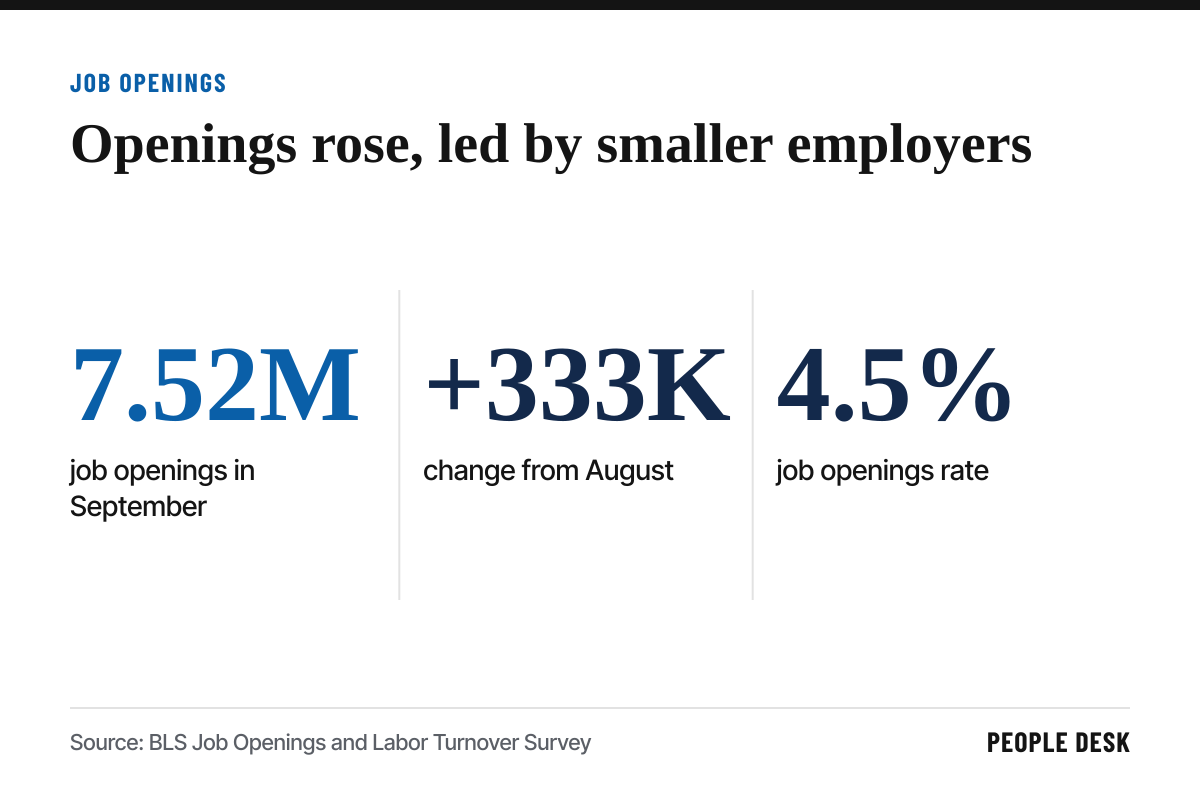
The Bureau of Labor Statistics reported that job openings rose by 333,000 to 7.52 million in September. The openings rate climbed to 4.5 percent from 4.3 percent in August. August was revised up by 111,000. The September figure was the highest since May and topped every estimate in Bloomberg's survey of economists.
Layoffs and discharges fell to 1.64 million, the lowest since March 2025, according to Reuters. Quits rose by 321,000 to 3.37 million, the highest level since March 2025, pushing the quits rate to 2.1 percent. Reuters calculated that there were 1.06 job openings for every unemployed person.
Where the openings were
Reuters reported that nearly all of September's new openings were at small businesses, while vacancies actually fell at establishments with 50 to 249 workers. State and local government outside education accounted for just under a third of the increase, adding 104,000 openings, a trend we cover in our report on public sector hiring.
Resignations followed the same pattern. Nearly all of September's increase in quits came at small and medium-sized businesses, Reuters reported. Accommodation and food services saw the largest jump, with quits rising by 197,000 in that sector alone, according to the BLS. We look at that industry in our hospitality turnover report.
Why small businesses feel it first
Small employers tend to feel labor market shifts faster than large ones. They usually have less room in their budgets to match pay offers, fewer internal promotion paths and less formal recruiting infrastructure. When workers gain confidence and start looking around, a small business may lose an employee before it even realizes that person was unhappy.
Small businesses also have less margin for vacancies. A large manufacturer can spread one open position across a shift. A ten-person company may lose a meaningful share of its capacity when a single experienced employee leaves.
What small employers can do
The good news is that small businesses have advantages too. They can move faster, offer more flexibility and give employees direct access to owners and decision makers. Those strengths matter to many workers, especially when a larger competitor's hiring process takes weeks.
Speed is one of the easiest advantages to use. SHRM's 2026 benchmarking puts the median time to fill nonexecutive positions at 39 days. A small business that can interview within a few days and make an offer within a week will win candidates that larger employers lose. We explain how in our guide to hiring speed.
Retention requires attention from the top. Owners and managers of small businesses should hold regular one-on-one conversations, ask employees what would make them stay, and act on what they hear. A simple stay interview, which we describe in our stay interview guide, can surface problems months before they turn into resignations.
Benefits do not have to be expensive to matter. Predictable schedules, paid time off that employees can actually use and a clear path to more responsibility often weigh more heavily than a richer health plan a small business cannot afford. Employees at small firms frequently value being known by name and having a voice in how the work gets done.
Pay still matters. A small business does not need to beat every competitor on wages, but it does need to know where it stands. Reviewing current job postings in your area, especially in states that require salary ranges in postings, gives a quick read on the market rate for each role.
What comes next
Owners should also watch their own numbers. Tracking who leaves, when and why, even in a simple spreadsheet, turns a vague sense of turnover into specific problems that can be fixed. A pattern of departures in the first 90 days points to hiring and onboarding issues, while departures after two or three years usually point to pay or growth.
One month of strong openings and rising quits does not guarantee a tight labor market through the winter. The October jobs report, which showed 165,000 new jobs, suggests employers were acting on those openings. The next JOLTS release, covering October, will show whether the shift held.
Sources
- Colorado Biz via Reuters, US Job Openings Rise in September
- Honolulu Star-Advertiser via Reuters, U.S. Job Openings Jump as Resignations Surge
- Virginia Business via Reuters, Job Openings Jump in September
- U.S. Bureau of Labor Statistics, Job Openings and Labor Turnover Summary
- TheStreet Pro, JOLTS Report Strong Across the Board
- SHRM, 2026 Recruiting Benchmarking Data Brief
We link to the original reports and filings wherever possible. See something we got wrong? Tell us and read our corrections policy.


