The unemployment rate gets most of the attention each month, but it leaves out a large group of people. Anyone who is not actively looking for work is not counted as unemployed, even if they would take the right job tomorrow. For employers struggling to fill roles, that group may be the most promising place to look.
What the October numbers show
The Bureau of Labor Statistics reported that the labor force participation rate was 61.9 percent in October, up slightly from 61.8 percent in September. The employment-population ratio was 59.3 percent. Both measures have shown little net change since January, the agency said. The labor force grew by 421,000 people during the month.
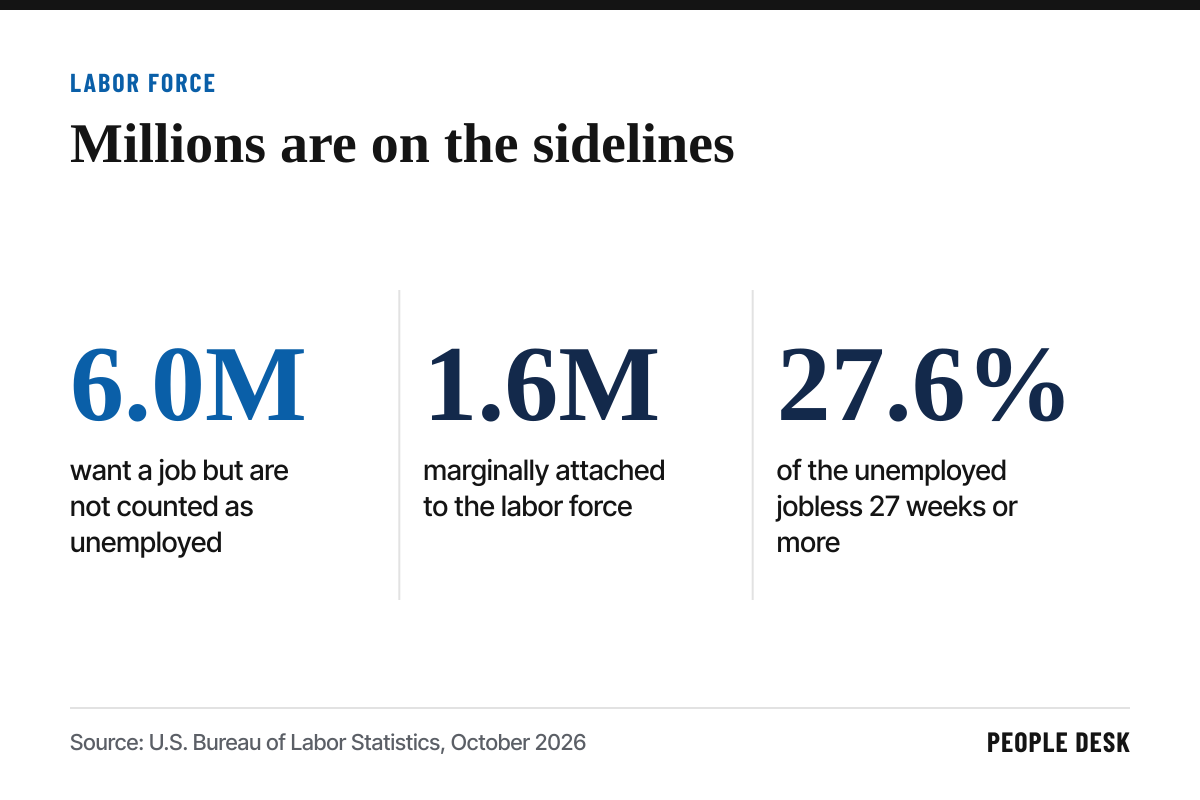
Beneath those totals sits a sizable pool of potential workers. In October, the number of people not in the labor force who currently want a job was about 6.0 million. Among them, 1.6 million were marginally attached to the labor force, meaning they wanted work, were available and had looked for a job sometime in the prior year, but not in the past four weeks.
Long-term unemployment is another pressure point. People who had been jobless for 27 weeks or more accounted for 27.6 percent of all unemployed people in October, according to the BLS.
Why the labor force is not growing faster
Demographics explain much of the slow growth. Retirements continue to pull experienced workers out of the labor force. Staffing Industry Analysts noted in its August analysis that a drop in immigration has left retirements outpacing new labor force entry. SIA estimated that the break-even rate of monthly job growth, the pace needed to keep unemployment steady, may now be as low as negative 10,000 to positive 30,000 jobs.
That has two implications. First, a monthly jobs report showing modest gains may describe a tight market rather than a weak one. Second, employers cannot count on population growth to refill their applicant pools. They have to draw in people who are currently outside the market.
Kentucky illustrates the challenge. The Kentucky Chamber of Commerce reports that participation fell by 0.6 points in both the state and the nation between November 2025 and March 2026, and Kentucky has historically trailed the national rate. We explore the state picture in our Kentucky labor force analysis.
Who is on the sidelines
People outside the labor force are not a single group. They include parents managing childcare, caregivers for older relatives, people with health conditions that limit certain kinds of work, older workers who retired early, people with criminal records who have been screened out repeatedly, and workers who gave up after long searches.
Each group responds to different changes. Parents look for predictable schedules and shifts that fit school hours. Caregivers need flexibility and leave policies they can rely on. Older workers often want part-time or phased schedules. People with records want a fair, individualized review rather than an automatic rejection, an approach the EEOC has long encouraged and that we discuss in our background check guide.
Employers sometimes assume people outside the labor force lack skills or motivation. Workforce boards report a different picture. Many have solid work histories and left for reasons that a different schedule, a shorter commute or a supportive supervisor could address. Treating them as experienced candidates rather than charity cases changes how they respond to an offer.
Changing the job to widen the pool
The employers that successfully hire from the sidelines usually redesign some part of the work. They offer shorter shifts or split shifts. They publish schedules further in advance. They remove degree requirements that the job does not truly need. They partner with transit agencies, childcare providers and workforce boards to address the barriers that keep people from applying.
In Louisville, organizations such as KentuckianaWorks and Greater Louisville Inc. already work on those barriers, which we cover in our report on barriers to work. Employers that use those resources gain access to candidates competitors never see.
Finally, employers should make sure their hiring process does not screen out the people they want. Long online applications, rigid availability requirements and slow responses all discourage applicants who are cautiously reentering the workforce. A short mobile application and a quick call back can matter more than a higher starting wage. Our guide to hiring frontline workers faster covers those steps in detail.
Sources
- U.S. Bureau of Labor Statistics, The Employment Situation for October 2026
- U.S. Bureau of Labor Statistics, Employment Situation Summary
- Hunt Scanlon, U.S. Economy Adds 165,000 Jobs in October
- Staffing Industry Analysts, August 2026 US Jobs Report
- Kentucky Chamber of Commerce, State of the Economy
We link to the original reports and filings wherever possible. See something we got wrong? Tell us and read our corrections policy.


